Many Journeys, One Pack: Making Returnable Transit Packaging Pay Its Way
For most UK despatch operations the parcel is a consumable: bought, filled, sealed and gone. Businesses running rental, repair, refurbishment or resale flows work to a different logic. There, the transit pack is a piece of equipment with a working life, and the question is not how cheaply it can be bought but how many times it can be sent before it must be retired. That shift in perspective changes almost every decision that follows, from the material specification to the way a goods-in team inspects what comes back.
Begin with the loop, not the container
Before comparing formats, map the journey the pack will actually make. A typical loop runs outbound despatch, a dwell period with the customer, a return leg, receipt and inspection, cleaning where required, and reissue. Each stage imposes its own demands. The outbound leg stresses the closure and the outer surface; the customer dwell period stresses ease of opening and repacking; the return leg is usually the least controlled, because the customer rather than the warehouse prepares the parcel.
Two numbers determine whether returnable packaging is worth pursuing at all: the number of trips a single unit will make in a year, and the proportion of units expected to be lost. Where an asset completes fewer than roughly half a dozen journeys annually, a well-specified single-use format will usually remain the more economical choice. Returnables come into their own when volumes are steady, the return path is reasonably predictable and the goods inside justify the administrative effort.
Which format suits which flow
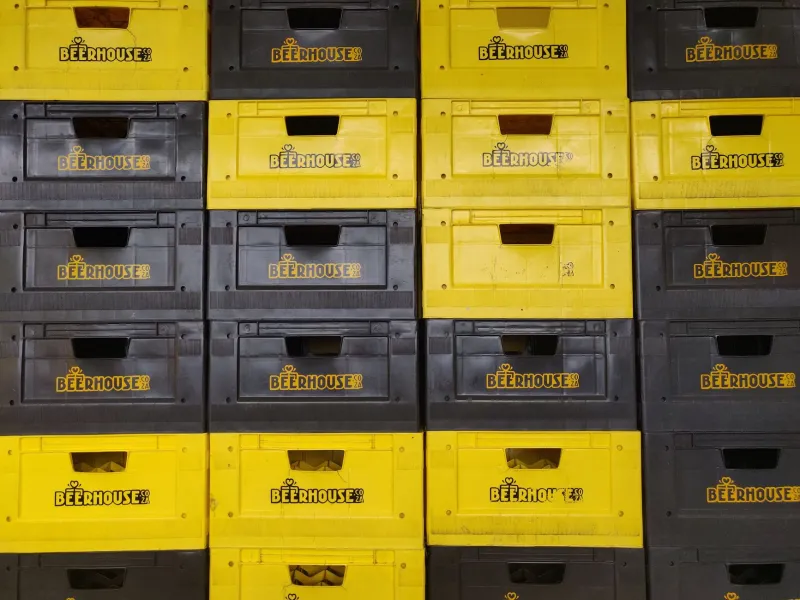
Rigid and semi-rigid cases suit repair and refurbishment work, where the contents are heavy, fragile or valuable and the pack must protect against impact in a mixed sortation environment. They stack predictably, tolerate repeated handling and can be fitted with internal cradles for specific products. Their weakness is empty-return volume: a case that does not nest consumes expensive space on the way back.
Padded mailers and fabric bags suit rental apparel, small accessories and lower-value items where flexibility matters more than rigidity. They are lighter and cheaper to move, but they offer less protection at the edges and their closures wear faster. Moulded inserts, whether pulp, expanded polymer or textile, bridge the two: they can be transferred between outer formats and replaced independently when they fail, which extends the life of the more expensive outer shell.
Whichever route is chosen, specify the empty-return behaviour explicitly. A nesting ratio of three to one is very different from a case that returns at full volume, and the difference will show up in return freight costs long before it shows up in the purchase price.
Test for the tenth trip, not the first
A single-use pack needs to survive one journey. A returnable pack needs to survive the number of journeys you intend to claim for it, plus a margin. Durability testing should therefore be structured around cycles rather than events.
A practical protocol includes repeated drop testing from handling heights at corners, edges and faces; closure cycling to failure, counted and recorded; hinge and latch fatigue; label adhesion and residue after repeated application and removal; compatibility with whatever cleaning agents the operation intends to use; and performance after exposure to cold and damp, which matters for packs that spend time in unheated vans and loading bays through a UK winter. Inspection criteria and a retirement threshold should be written down before the first unit goes into service, otherwise damaged packs circulate indefinitely because nobody has the authority to withdraw them.
Deposits, prepaid labels and other return incentives
The return leg is a behavioural problem as much as a logistical one. Deposits remain the most direct lever, but they carry administrative weight: they must be collected, tracked, refunded and accounted for, and the level must be high enough to matter without deterring the customer. Prepaid return labels enclosed with the outbound parcel reduce friction considerably and are often more effective than a deposit of equivalent value, because they remove the effort of arranging carriage.
Some operators combine the two: a modest deposit refunded on return, plus a prepaid label inside the case. Others charge a replacement fee after a defined period and state it plainly at the point of order. Whatever mechanism is chosen, the terms should be unambiguous and consistent across channels, including marketplace listings where the customer may never see the operator's own website.
Cleaning, marking and the identity of a reusable pack
A returnable pack without a unique identifier is simply an anonymous box, and anonymous boxes cannot be tracked, audited or retired. A durable label or moulded barcode that survives cleaning gives each unit an identity, allowing the operation to record trips completed, flag units approaching their retirement threshold and identify a batch if a specific component fails.
Label strategy deserves early attention. Direct-applied paper labels leave adhesive residue that defeats subsequent scans, so a removable label pocket or a designated label zone that can be cleaned is usually preferable. Goods-in should have a defined inspection point and a quarantine bin, so that packs needing repair are separated rather than reissued by default.
What courier networks will accept
Returnable formats must work within the constraints of the carrier network, and those constraints are tighter than many assume. Oversized cases attract surcharges or fall outside automated sortation entirely. Protruding handles, straps and metal fittings can snag on conveyors. Non-standard shapes may require manual handling and a corresponding price. Flat, clean surfaces are needed for labels, and the pack should present a stable base for scanning equipment.
Before committing to a format, run a small number of live consignments through the intended service and confirm acceptance, pricing and liability arrangements in writing. Responsibility for a damaged reusable case in transit is often less clearly defined than for a cardboard box, and clarity at the outset prevents disputes later.
The arithmetic of cost per cycle
Cost per unit is a misleading metric for returnable packaging. Consider an illustrative comparison: a single-use double-wall box with void fill and tape costing around £1.10 per despatch, against a reusable case purchased at £18 and expected to complete 40 cycles. Straight-line depreciation gives £0.45 per cycle, to which must be added inspection, cleaning and any repacking labour, perhaps £0.25, and a provision for loss. At a five per cent annual attrition rate, the effective cost per cycle rises by roughly a further five per cent. On those numbers the reusable case is comfortably cheaper, but the conclusion reverses quickly if average cycles fall to ten or if return freight is charged at full parcel rates.
The calculation should be repeated with the operation's own figures, and refreshed as volumes change. It is also worth separating the cost of the return leg from the cost of the outbound journey, since many businesses already pay for returns under a separate arrangement.
Start with a controlled pilot
A single product line, a single return route and a six to eight week window will reveal more than any amount of specification work. Record trips completed, loss rate, damage rate and the labour minutes consumed per cycle, then compare against the single-use baseline. Packs that earn their keep will make themselves obvious; those that do not will show up in the returns data long before they show up in the accounts.