A Handle on Access: Designing Parcels That Open Without a Struggle

Parcel packaging is usually judged against a straightforward brief: protect the goods, survive the courier network, present the brand and meet the budget. That brief is necessary, but it stops short of the moment when the parcel is actually opened. For customers with limited grip strength, arthritis, a temporary injury or simply one free hand, the last mile is not a scan event. It is a physical task that can end in frustration, damaged goods or a call to customer services.
UK businesses do not need to treat accessibility as a specialist project. It can be handled as a normal part of packaging specification, alongside drop testing and chargeable-weight reviews. The aim is not to make every parcel effortless for every person. It is to remove avoidable barriers while keeping the pack secure, recognisable and commercially sensible.
Opening force belongs in the specification
Most packing benches already assess whether a parcel will stay closed. Fewer assess whether it can be opened. That gap matters because closure performance and opening performance are not the same measurement. A heavy-duty tape may pass a transit trial and still demand more grip strength than a customer can apply.
A practical starting point is to add a simple three-point check to the packaging specification.
- Peel initiation: how much force is needed to lift the first edge of tape or start a tear strip?
- Controlled opening: once started, does the pack open in a predictable line, or does it tear into the goods?
- Inner access: after the outer seal is broken, can the customer reach the product without tools, excessive force or a second struggle?
A spring balance or simple pull-force gauge can give a repeatable reading at the bench. The exact number matters less than consistency. If two similar parcels require very different opening forces, the specification is probably relying on habit rather than design.
Tape placement is a design decision
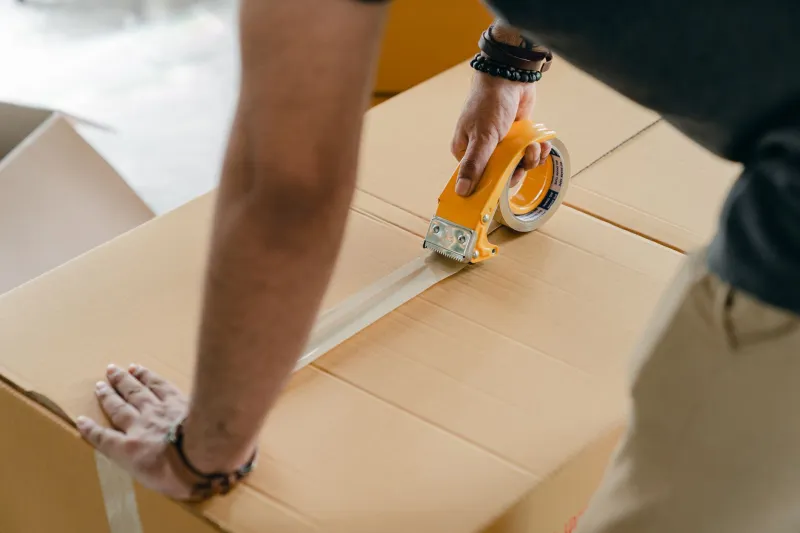
Tape is often applied for speed and certainty. That is understandable in a busy operation, but a full wrap of heavy tape around a small parcel can turn a routine opening into a test of hand strength. Small changes usually preserve security without adding cost.
First, avoid covering the tear strip or finger-lift tab. If the pack has a built-in opening feature, the tape should work with it, not seal it shut. Second, consider an offset tape pattern rather than a full wrap. A central seam strip with a folded end tab can provide tamper evidence while giving the customer a clear place to start. Third, match tape width and adhesive strength to parcel size. A small, light carton rarely needs the same closure force as a heavy transit case.
There is also a common misconception to address. A parcel that is difficult to open is not automatically more secure. Tamper evidence comes from a seal that shows interference clearly, not from excessive adhesion. Patterned tape, void labels, serialised seals and consistent seam placement all do more for security than layers of generic tape.
Inner pack access is part of the experience
Many customers reach the product only after a second opening task. Void fill may cling to the item, inner bags may be sealed with strong adhesive, or the product may be wrapped in a way that requires scissors. Each layer adds time and risk.
Where possible, choose inner materials that can be torn by hand or lifted with a clear starting point. Paper-based void fill, perforated bags and folded corrugate inserts are often easier to manage than tightly sealed plastic or heavy-duty strapping. If a tool is genuinely required, state that clearly on the outer pack. A simple instruction such as 'open with scissors' is better than leaving the customer to guess.
The principle is straightforward: the number of barriers should match the level of protection required. A fragile item may need more than a resilient one. But every barrier should have a purpose, and every purpose should be obvious to the person opening the parcel.
Test with people, not only with machines
Laboratory tests are valuable, but they do not capture the lived experience of a customer on a wet doorstep in November. A small internal panel can add useful perspective. Include colleagues with reduced grip strength, older colleagues or anyone who has recently had a hand or wrist injury. Ask them to open a sample parcel without instruction, record whether tools were needed and note where the pack failed.
This is not a focus group and it does not need to be elaborate. Ten minutes with five representative people can reveal whether a tape tab is too small, a tear strip is misaligned or an inner bag is too tight. The findings should feed into the specification, just as a drop test would.
For UK businesses, the context is also practical. Doorstep conditions are often wet, cold and hurried. Customers may be wearing gloves. They may be holding a child or a walking aid. They may be opening the parcel next to a recycling bin and want to separate materials quickly. Accessible opening is therefore not only about disability. It is about the real conditions in which packaging is used.
Making the commercial case
Accessible opening does not have to mean a more expensive pack. In many cases, it means using less tape, simplifying inner layers and standardising a tear feature across a product family. Those changes can reduce material use and packing time while improving the customer experience.
Where a new feature does add cost, such as a finger-lift tab or a perforated tear line, the business case should include the avoided costs of damaged returns, contact-centre queries and repeat purchases lost through frustration. These costs are often dispersed across departments, which is why they are easy to overlook in a packaging review.
Ahead of the 2026 peak season, there is a sensible opportunity to review the ten highest-volume lines. Check the opening route for each one. Confirm that the tape placement leaves a starting point. Make sure the inner pack can be accessed without a struggle. Then update the specification so the improvement survives the next round of cost pressure.
A short checklist for the packing bench
- Add peel initiation, controlled opening and inner access to the standard packaging check.
- Keep tape away from tear strips, tabs and perforations.
- Use tamper evidence deliberately rather than relying on excessive adhesion.
- Reduce unnecessary inner layers and give customers a clear starting point.
- Test samples with people who have limited grip strength or one free hand.
- Record the findings and update the specification.
The last mile is not only a delivery route. It is also the few minutes a customer spends getting into the parcel. Designing for that moment is a practical way to protect goods, reduce avoidable friction and make packaging work properly from despatch to doorstep.