Label Geometry and the First-Time Scan: A Packing-Bench Guide for UK Couriers

A parcel's journey through a UK courier network begins with a single act: someone points a handheld scanner at a label and expects an immediate read. When that read fails, the parcel does not simply wait where it is. It is turned, re-presented, sometimes set aside, and occasionally routed to a manual exception process. The cost is rarely dramatic in isolation, but across a day's dispatch it accumulates into missed cut-off times, duplicated handling and avoidable customer contact.
Most scan failures are treated as a courier issue. In practice, many are packaging issues that were present before the parcel left the bench. Label position, print contrast, surface curvature and the way film or tape crosses the barcode all influence whether a handheld reader can decode the symbol quickly. Designing for the first-time scan is therefore not a dispatch detail; it is a packaging specification decision.
The read window is smaller than it looks
Handheld scanners used by UK courier and postal operators are designed to cope with imperfect conditions, but they still need a usable read window. The barcode must be presented at a reasonable angle, at a sensible distance and without obstruction. On a flat, well-lit label the read is usually instantaneous. On a curved parcel with a creased label and a strip of glossy tape across one edge, the scanner has to work harder.
The practical implication is that labels should be treated as part of the parcel's geometry, not as an afterthought applied at the end of packing. A label placed over a seam, a corner or a recessed area is more likely to distort. A label applied to a curved surface may still scan, but the margin for error narrows. Where a parcel is likely to be handled quickly, the aim should be to preserve as much flat, unobstructed label area as possible.
Placement: keep the symbol clear and accessible
The most reliable position is usually the largest flat face of the parcel, clear of seams, closures and the natural curve towards an edge. The barcode itself should sit away from the parcel edge by a comfortable margin. This reduces the chance of edge-wrap, where part of the label folds over the corner and the symbol is distorted or partially hidden.
Where a parcel has a natural top face that will be presented to the scanner, placing the label there can improve consistency. If the parcel is likely to be stacked, consider whether the label will be compressed or obscured by another parcel. If the parcel is likely to be handled on a conveyor, consider whether the label faces a consistent direction. The objective is not to predict every handling position, but to avoid obvious placement choices that make a first-time read less likely.
Contrast, gloss and the wrong kind of shine
Barcode readability depends on contrast between the symbol and its background. A label printed with adequate darkness on a matte stock is generally more forgiving than one printed lightly on a glossy surface. Glossy laminates and shiny tapes can reflect scanner light back into the reader, reducing effective contrast. This is particularly relevant under warehouse lighting and in vehicle cabs where the angle of reflection changes as the parcel is turned.
Operators should also consider the condition of the print. Thermal printers can produce faded or patchy symbols as heads wear or media quality changes. A label that looks acceptable to the eye may have lower contrast than the scanner requires. Regular print checks, using the same label stock and printer settings as production, are more useful than occasional visual inspections.
Curvature, creases and edge wrap
Curvature is not automatically a problem. Many parcels are cylindrical or irregular, and scanners can often read labels on curved surfaces. The difficulty arises when curvature combines with creasing, poor adhesion or a label that bridges a recess. A label applied over a void can sag or wrinkle. A label applied too tightly around a corner can lift at the edge.
Application technique matters. Smoothing a label from the centre outwards, rather than from one edge, helps prevent trapped air and creases. Where possible, avoid applying labels over joins in the outer packaging. If a parcel format consistently produces edge-wrap, consider a smaller label, a different label position or a packaging change that creates a flatter application surface.
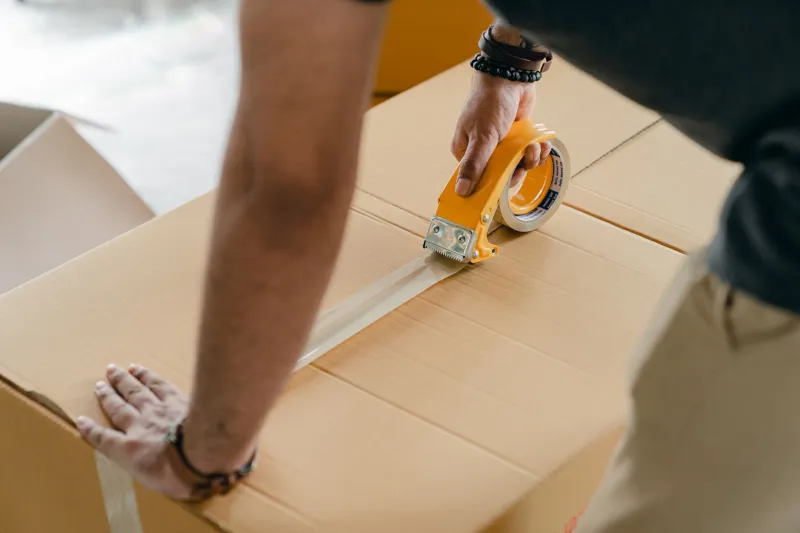
Tape and film deserve separate attention. Clear tape over a barcode may seem harmless, but it can introduce glare and, if wrinkled, distort the symbol. A tape line that crosses only the quiet zone or the edge of the label is less risky than one that crosses the centre of the barcode. The simplest rule is to keep the barcode area free of tape, film and overlapping label material.
Test against the scanners that will actually be used
A label that scans on a desktop reader in the office may behave differently on a courier's handheld device. Testing should use the scanner types and settings that will handle the parcel in practice. Where multiple carriers are used, test a sample against each relevant device rather than assuming one result applies to all.
A practical test is to prepare a small batch of parcels representing the normal range of sizes and surfaces. Apply labels using the intended production method, including the correct printer and stock. Present each parcel at several angles and distances, including the quick, one-handed presentation typical of a busy dispatch bench. Record any failures and note whether they relate to placement, contrast, curvature or obstruction. This does not need to be a formal laboratory exercise; a consistent bench test is enough to reveal recurring problems.
A three-step scan check at the bench
A simple routine can catch most avoidable issues before dispatch. First, check placement: is the barcode on a flat, clear area and away from edges, seams and closures? Second, check the surface: is the label smooth, free from creases and clear of tape or film over the symbol? Third, check the read: scan the parcel once with the production scanner or a representative device before it enters the dispatch pile.
This third step is often skipped because it adds a few seconds per parcel. In practice, a single failed scan at the bench is cheaper than a failed scan at the courier hub. The check should be built into the packing routine, not treated as a separate quality-control stage. For temporary peak teams, the routine should be demonstrated and posted at the bench in plain language.
Specify what matters
Packaging specifications often describe box dimensions, board grade and void fill, but say little about label application. Adding a short label section can make a meaningful difference. Specify the approved label position, the required clearance from edges and seams, the label stock and print method, and the requirement to keep the barcode area free of tape and film. Include a note on the scan check and the device used for verification.
The first scan is not a courier formality. It is the point at which the packaging design meets the operational reality of the network. By treating label geometry, contrast and application as part of the packaging specification, UK businesses can reduce avoidable handling and give every parcel a better chance of moving cleanly from bench to doorstep.